
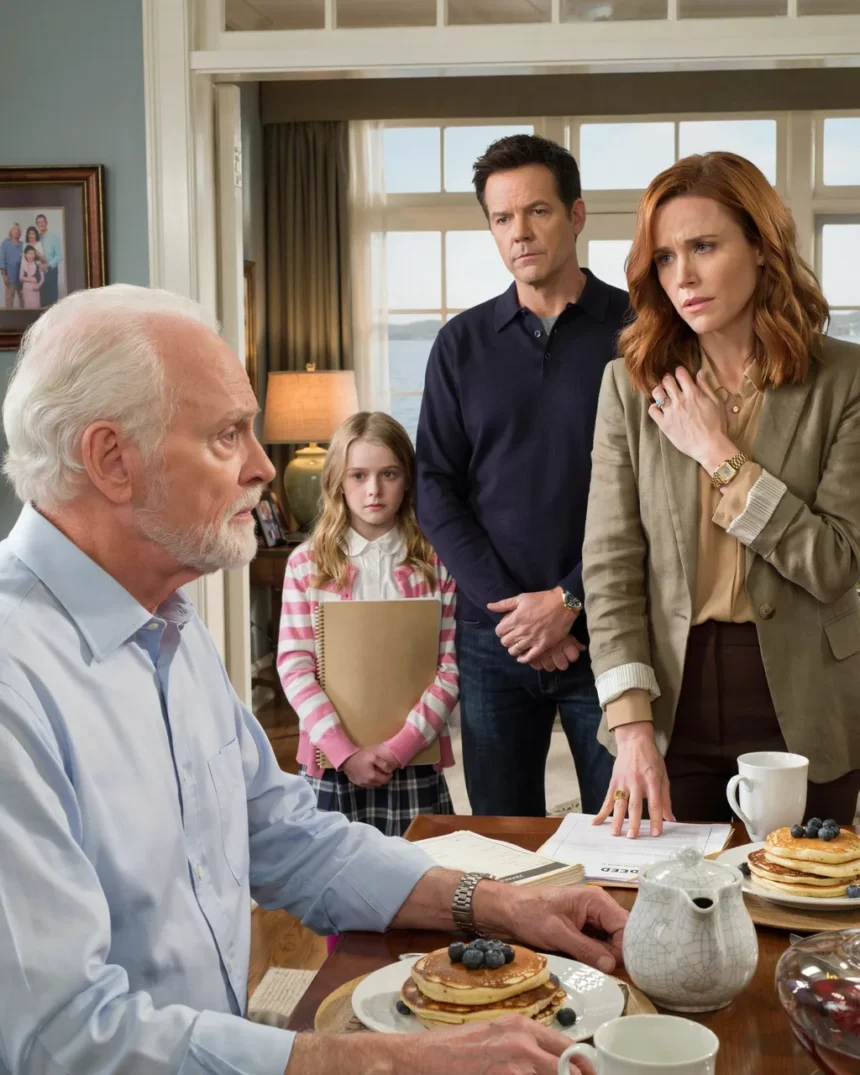
She looked at me for a long moment. Then she stood. Not quickly.
Not dramatically. She pushed her chair back, placed both palms on the table, and rose with the cold control of a person who had not expected resistance and did not intend to tolerate it. Marcus said, “Brin, sit down.”
There it was again.
A sentence shaped like action, empty at the center. She walked around the table toward me. I did not move.
Maybe I should have. Not because I was afraid, but because distance is sometimes wisdom. Yet part of me still believed in rules.
In family. In the basic human decency that says a person may argue, pressure, manipulate, even insult, but there is a final invisible line they do not cross on a Sunday morning in front of pancakes and a child’s half-finished juice. Brin crossed it.
Her hand struck my face hard enough to turn my head and send my hearing aid skittering across the porch floor. The sound it made was small. Almost delicate.
Plastic and metal against old pine. Tick. Slide.
Stop. For a moment, that was the only sound in the world. I did not stand.
I did not shout. I did not raise my hand. I sat with my cheek burning and my left ear ringing in that strange hollow way it does when the hearing aid is out and the world becomes far away.
The lake blurred, then steadied. The porch boards beneath my shoes became suddenly clear. The scratch near the chair leg from Hattie’s scooter.
The darker stain where Marcus had spilled grape soda when he was twelve. The knot in the wood shaped like a closed eye. Brin stood over me with her hand half-raised, as if even she had not fully caught up to what she had done.
Marcus looked up. He saw me. He saw his wife.
He saw the hearing aid on the floor. And in that suspended second, I gave my son one final chance without saying a word. I waited for him.
Not for an apology from her. Not for panic. Not for drama.
I waited for my boy, my only child, the man I had carried through snow and debt and every soft landing I could afford to build for him, to stand up and become someone Helen would recognize. His face went pale. His mouth opened.
And he said, “Dad, why do you have to make everything so difficult?”
That sentence did more damage than Brin’s hand ever could have. I looked at him, and something inside me stepped backward. It is the only way I can describe it.
The father in me did not die. That would be too simple, too clean, and life is rarely kind enough to make heartbreak clean. But he stepped backward.
He moved away from the table. He stopped reaching. He stopped explaining.
He stopped believing that love alone could make a man brave. The porch returned by pieces. The lake.
The folder. The sugar bowl. The smell of coffee.
Marcus breathing. Brin whispering, “Theo…”
I bent slowly and picked up my hearing aid. My fingers were steadier than I expected.
I wiped it on the front of my shirt, checked it out of habit, and placed it back in my ear. The world clicked in with a soft electronic hiss. Brin had already begun rearranging her face.
That is what I remember most clearly. Not the strike. Not the sting.
Her face. She was building the aftermath before the moment had even ended. Her eyes became wet.
Her mouth trembled. Her shoulders lowered. She was preparing to become the person who had been pushed too far, who had been under pressure, who had only wanted to help, who had done one regrettable thing because an old man made everything impossible.
“I’m sorry,” she said quickly. “I didn’t mean—”
“You meant to.”
Her mouth closed. Marcus stood halfway.
“Dad—”
I lifted one hand. He stopped. I looked at Brin.
Then at him. I had never felt calmer in my life, and that calm frightened me more than anger would have. “Go inside,” I said, “and pack your bags.”
Brin stared at me.
“What?”
“You’re leaving.”
She gave a short, disbelieving laugh. “Theo, don’t be dramatic.”
“You’re leaving my house.”
“Your house?” she said, and there it was again, the resentment under the polish. “This is exactly what I mean.
Everything has to be yours. Your house. Your grief.
Your rules. No one else gets to have a say.”
“No,” I said. “Not in this.”
Marcus took a step toward me.
“Dad, can we just talk?”
I turned to him. “We did talk. I asked if this was what you wanted.
You let her answer. She put that paper in front of me. I said no.
She crossed a line. You asked me why I was difficult. That was the conversation.”
His face tightened.
For full cooking steps, turn to the next page or click the Open button (>) and don't forget to SHARE with your Facebook friends.
