
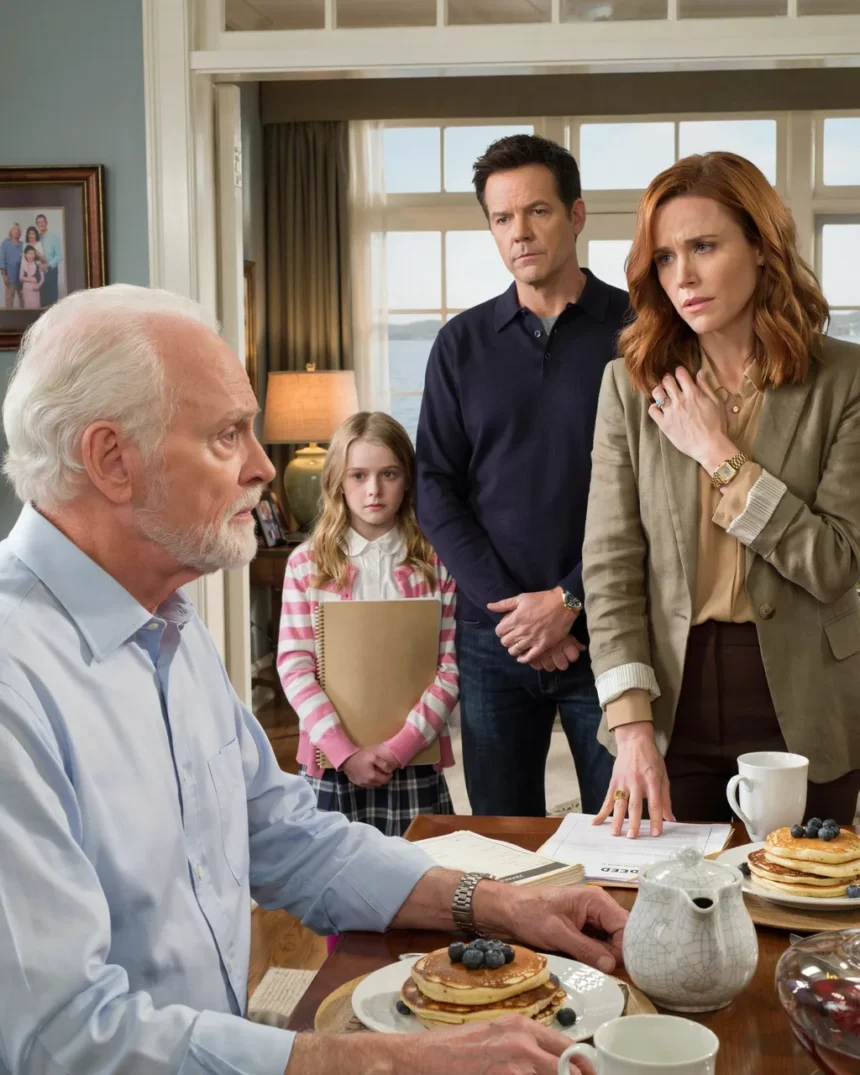
I have heard people say grief comes in waves. They say it because it sounds pretty and because it is often true. But sometimes grief is not a wave.
Sometimes it is a trapdoor. One moment you are standing in your life, and the next you are falling through every year you ever loved. I saw Helen’s hand on that bowl.
I saw her laughing when she dropped it in 1993 and decided the crack gave it personality. I saw her during treatment, stirring sugar into tea she could barely drink because she said routine mattered. I saw her sister Roberta carrying the same bowl to the porch after the funeral because nobody knew what else to do with their hands.
And across from me sat a woman who had just reduced it to ceramic. I said, very quietly, “I’m not signing.”
Brin blinked. Marcus closed his eyes as if he had been waiting for an accident and finally heard the metal hit.
“Theo,” Brin said, “I don’t think you’re understanding the situation.”
“I understand it.”
“You are alone.”
“Yes.”
“You’re aging.”
“Everyone is.”
“You are emotionally attached to a property that requires more upkeep every year.”
“I am emotionally attached to many things that require upkeep. My dignity, for example.”
Marcus looked at me then. It was the first real look he had given me all morning, and it was not the look of a son recognizing his father’s pain.
It was the look of a man whose private discomfort had just become public. Brin’s hand flattened on the table. “You always do this,” she said.
“Do what?”
“Turn every practical conversation into a memorial for Helen.”
Marcus whispered, “Brin.”
Too late. Too soft. Too useless.
I looked at my son and saw that he wished she had not said it. But wishing is a long way from standing. “What did you say?” I asked.
Brin lifted her chin. “I said you hide behind grief whenever anyone tries to talk about reality.”
The lake moved behind her. A breeze came through the screens.
The napkin near Hattie’s empty plate fluttered once and lay still. Marcus said, “Can we just take a minute?”
I said, “No.”
Brin gave a small laugh under her breath. “Of course not.”
“No,” I repeated.
“Not today. Not next year. Not ever.
The house stays in my name.”
“Theo, that is selfish.”
There are words that reveal an entire soul because of where they are placed. Selfish would have been letting the house rot so no one else could enjoy it. Selfish would have been cutting Hattie out because I was angry at her mother.
Selfish would have been pretending Marcus owed me obedience because I had helped him. But refusing to hand my home to a woman who treated my memories like obstacles? No.
That was not selfish. That was overdue. I sat back down slowly.
The chair creaked under me. “Brin,” I said, “this is the house where I held my wife’s hand when she was leaving this world. This is where my granddaughter learned to swim.
This is where Marcus came after his first heartbreak and slept on the couch for three days while Helen made chicken soup he pretended not to need. This is where I have lived every good year and every hard year that mattered. You see square footage.
I see my life.”
For full cooking steps, turn to the next page or click the Open button (>) and don't forget to SHARE with your Facebook friends.
