
That was the father I planned that dinner for.
Not the man who ended up looking at the floor while my children stood in a doorway holding his present.
The lobby at Bellisimo smelled like garlic butter and warm bread and expensive candles. The kind of candles that make a restaurant feel softer than it actually is.
The hostess stand glowed under yellow light. The glass doors behind us reflected my little family back in pieces.
Me in a pale blue sweater I’d bought for the occasion.
Lucas in his hoodie with both arms wrapped around a birdhouse.
Mia beside me, walking carefully because she did not want to bump her brother’s elbow and ruin the surprise.
They had painted that birdhouse in our garage the Saturday before.
Lucas used too much blue on one side and then got defensive when Mia told him it looked like the sky had spilled on it.
Mia painted flowers around the roof with a brush so small she had to stick her tongue out to concentrate.
When it dried they argued for ten solid minutes about who got to write GRANDPA on the bottom.
I let them both do it.
Two crooked names, two different colors, one small wooden house covered in a great deal more love than skill.
I planned that entire dinner.
Not Diane. Not my dad. Me.
I called relatives in three states to find out who could come. I compared menu packages and picked the one Dad would actually eat instead of the one Diane would call classy. I confirmed the private room twice, once by phone and once by email.
At 2:14 that afternoon, the confirmation was still sitting in my inbox.
My name on it. My phone number on it. My card attached to an eight-hundred-dollar non-refundable deposit.
Bellisimo had also sent a private dining event sheet, which I read in the car line at school pickup while the twins argued in the back seat about whether Grandpa liked blue or green better.
That sheet had the room minimum, the deposit, the menu, the timing, and my name listed at the top.
Host contact.
I didn’t think much about that phrase then.
It sounded like responsibility.
I had no idea it was about to become evidence.
My sister has always been complicated, which is the polite word families use when they’ve gotten tired of saying cruel.
She’s my sister by blood. By temperament she has always behaved as though love is a room with limited seating.
Somebody else getting attention meant she was losing oxygen.
If I got praised for a report card, she developed a headache. If I got into college, she told people I’d probably charmed somebody in admissions. When I got married, she wore a white dress to my wedding and called it champagne.
When Lucas and Mia were born, she stood beside my hospital bed with grocery store flowers and asked me, smiling, whether twins ran on my husband’s side of the family.
She has always known exactly how to build a sentence that sounds harmless to everybody in the room except the person it was aimed at.
And my father always had one answer.
Be the bigger person.
For thirty years I thought he meant grace.
That night I finally understood that some people say grace when what they’re actually asking for is silence.
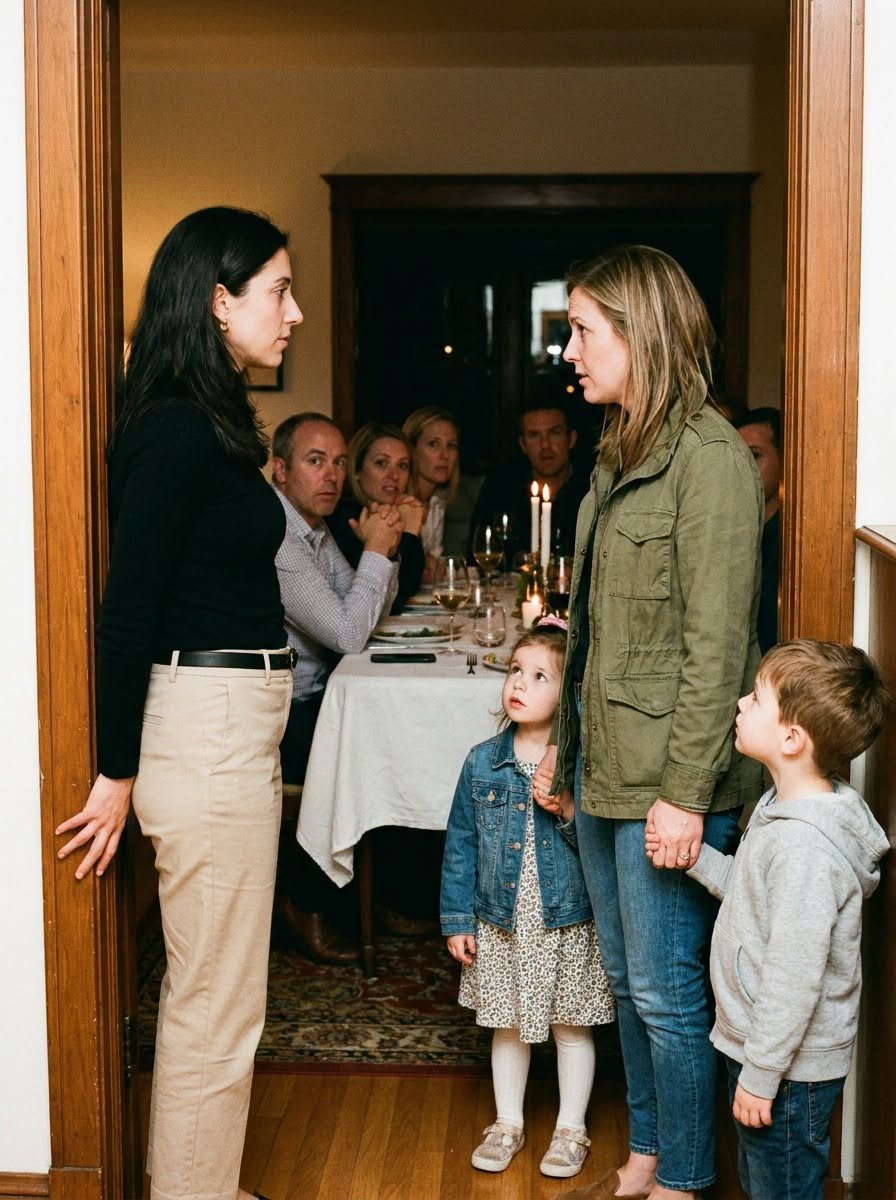
When I pushed open the door to the private room, Diane was already standing near the entrance.
She had her arms folded in that particular way she has, where her body becomes a locked gate.
She didn’t smile. She didn’t greet my children. She didn’t look at the birdhouse.
She looked directly at Lucas and Mia and said it.
“We didn’t make extra room for your irritating kids.”
It didn’t land loudly. That’s what made it so much worse.
It slid into that room clean and practiced, like she’d said it once in a mirror to get the rhythm right.
For a second nobody in there breathed correctly.
Uncle Brett stopped with his fork halfway up. Aunt Carol’s napkin crumpled in her fist. One of my cousins stared into the bread basket like bread had suddenly become the most fascinating object on earth.
A water glass caught the chandelier light and trembled, because somebody’s knee was going under the table.
And my father was standing behind her with his shoulders rounded and his eyes on the carpet.
Nobody moved.
Lucas looked up at me first.
Mia squeezed my fingers so hard her nails left little crescents in my palm.
The birdhouse tipped in Lucas’s hands and for one terrible second I thought it was going to hit that restaurant floor and break apart in front of fourteen people.
I waited for my father to say something.
That’s the part I remember most clearly. Not Diane’s voice. Not the silence around the table.
The waiting.
I wasn’t asking him to fight my battles. I wasn’t asking him to humiliate his daughter on his own birthday.
I was waiting for one ordinary grandfather sentence.
Something as small as, “They’re my grandkids.”
Something as plain as, “Of course they have seats.”
Anything at all that would tell two seven-year-olds they belonged in a room where their own grandfather was being celebrated.
Dad cleared his throat.
“Kristen.”
His voice came out low and embarrassed, and my stomach turned over, because somehow the embarrassment was pointed at me.
“Maybe it’s better if you head out. You know how Diane gets when things aren’t arranged her way.”
There are sentences that don’t look violent written down and still change the shape of a family permanently.
That was one.
For one ugly heartbeat I wanted to be as loud as the pain in my chest.
I wanted to tell my sister exactly what kind of woman looks at two children holding a handmade gift and decides they’re the inconvenience.
I wanted to ask my father when his daughter’s mood had become more important than his grandchildren’s hearts.
I wanted to say every single thing I had swallowed since I was nine years old.
But Lucas was watching me.
Mia was listening.
Children remember how you leave a room that hurt them. They remember it for decades.
So I took one breath. Then another.
I tightened my hand around theirs and said, “We’re going.”
Diane’s mouth twitched.
Not a full smile. Worse than that. The small private satisfaction of somebody who believes a room has just obeyed her.
My father still did not look up.
The hallway outside felt too bright. The hostess glanced at us and then went straight back down to her screen.
I could hear people laughing at the bar. Somebody ordering another round. The kitchen door swinging open with a burst of heat and garlic.
The world kept moving in that rude way it does when yours has just cracked down the middle.
In the parking lot the air was colder than it should have been for September.
Our SUV sat under a weak lamp looking like the only familiar thing left in the county.
Lucas got into the back seat without a word, still holding that birdhouse against his chest.
Mia buckled herself in and asked, “Mom, why are we leaving Grandpa’s party?”
I lied, because the truth was too heavy for a seven-year-old’s lap.
“Grandpa’s party is only for grown-ups tonight, baby.”
She accepted it, because she is seven.
Lucas did not.
For full cooking steps, turn to the next page or click the Open button (>) and don't forget to SHARE with your Facebook friends.
